


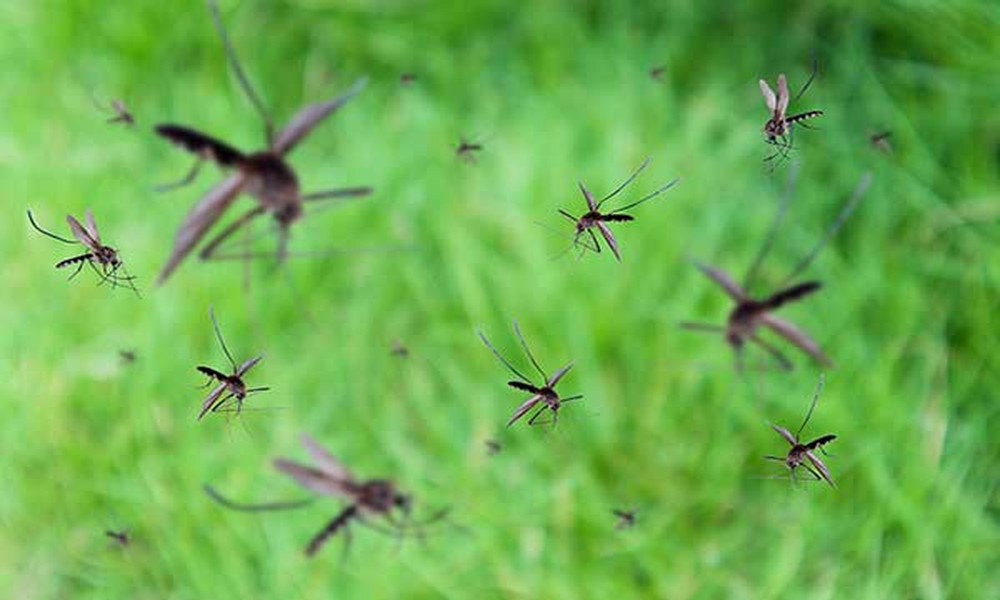
Most mosquito advice circulating online is either consumer product marketing or folk remedy, and the gap between those sources and what an entomologist would actually recommend is wide enough to explain why so many Kansas City backyards get no real relief. Mosquito control that works is built around the specific species in the area, their breeding biology, and the places they actually rest during the day. Kansas City pest control providers with a board-certified entomologist on staff, including ZipZap Termite & Pest Control in Lawson (one of fewer than 3% of pest management companies in the country with that credential), approach a backyard mosquito program differently than a technician working off a generic spray schedule, and the difference shows up in results rather than in marketing.
The Mosquitoes Actually Biting in Kansas City
Missouri hosts roughly 50 mosquito species, but three drive nearly all of the nuisance biting and disease transmission in residential Kansas City yards.
Culex pipiens, the northern house mosquito, breeds in stagnant water high in organic matter: birdbaths, clogged gutters, unattended rain barrels, catch basins, and neglected kiddie pools. It is the primary vector for West Nile virus in Missouri, a disease the Missouri Department of Health and Senior Services tracks every summer with confirmed positive mosquito pools across the metro.
Aedes albopictus, the Asian tiger mosquito, is the aggressive daytime biter that turns summer patios unusable. It breeds in astonishingly small water sources: bottle caps, plant saucers, discarded food containers, tree holes, and tarp folds. Unlike Culex, it bites all day rather than at dusk.
Aedes vexans, the inland floodwater mosquito, is the one that shows up in waves after heavy rains, particularly in neighborhoods near Clay County floodplains and the low-lying sections of Kansas City, Liberty, and Gladstone.
The treatment implications differ. Culex responds well to standing-water source reduction. Aedes albopictus requires vigilant attention to cryptic water sources that most homeowners overlook. Aedes vexans is harder to control on the property level because it is mobile and arrives from regional breeding sites.
Why Several Popular Products Do Not Actually Work
Bug zappers are close to useless for mosquitoes. Multiple university entomology studies, including work at the University of Delaware and the University of Notre Dame, have found that the insects killed in electric-grid zappers are overwhelmingly moths, beetles, and other non-biting species, with mosquitoes making up a tiny fraction of the catch. The CO2 and skin chemistry that draws mosquitoes to people is far more attractive than the UV light zappers produce.
Citronella candles reduce biting in their immediate vicinity (roughly a two-foot radius) but have little effect on a patio-sized area. Wristbands with repellent emitters perform similarly poorly in peer-reviewed testing.
Ultrasonic repellent devices, marketed heavily online, do not work. The American Mosquito Control Association has stated this explicitly for years, and controlled studies have consistently found no effect.
Essential oil spray programs marketed as “natural mosquito control” vary in effectiveness. Some plant-derived products (notably those based on lemon eucalyptus oil, geraniol, and certain pyrethrum formulations) have documented short-term repellent effects, but the claims around residual mosquito population reduction tend to outrun the evidence.
What Actually Reduces Mosquito Populations in a Backyard
Effective backyard mosquito control works on three axes simultaneously.
Source reduction is the foundation. A single bottle cap of water can produce dozens of Aedes albopictus adults, so the property walk-through matters more than any spray. Empty and refresh birdbaths weekly, clean gutters, drill drainage holes in tire swings and play equipment, manage low spots in the yard where water pools for more than a few days, and check plant saucers, tarps, children’s toys, pool covers, and wheelbarrows regularly. Corrugated drainage pipe that has collapsed internally is a hidden breeding site on many Missouri properties.
Larvicide handles the water that cannot be eliminated. Bacillus thuringiensis israelensis (Bti) products, sold as dunks or granules, are a biological larvicide that kills mosquito larvae without affecting fish, birds, pets, or other insects. Dropped into rain barrels, retention ponds, ornamental water features, and any standing water that persists more than a few days, Bti provides 30-day larval control with excellent environmental safety.
Adulticide targets adult mosquitoes resting on vegetation. Professional backpack mist applications of residual pyrethroids (bifenthrin, lambda-cyhalothrin) to the undersides of leaves, dense shrubs, fence lines, and shaded landscape beds reach the resting sites where adult mosquitoes spend daylight hours between blood meals. This is fundamentally different from fogging open air, which provides momentary reduction that dissipates within an hour.
A program that combines all three, cycled every three to four weeks through the May-to-September season, reduces resident mosquito pressure in a typical yard by a large margin.
Personal Protection Still Matters
Area treatment reduces population but does not eliminate biting entirely. CDC-recommended repellents (DEET at 20 to 30 percent, picaridin at 20 percent, oil of lemon eucalyptus, IR3535) applied to exposed skin remain the most reliable individual protection, particularly for households with children, older adults, or anyone with reduced mobility whose skin chemistry is particularly attractive to mosquitoes.
What Professional Kansas City Pest Control Adds
The main reason to hire professional mosquito service rather than run a DIY program is the combination of correct larvicide placement, proper backpack application of adulticide to actual resting sites, and the monthly cycle that matches mosquito generation time. Companies with an entomologist guiding the program, including Kansas City pest control providers like ZipZap Termite & Pest Control, also adjust the approach based on current species activity: shifting emphasis to source reduction during Aedes albopictus peaks, leaning harder on larvicide after a week of heavy rains, and adjusting treatment timing when West Nile positive pools are confirmed in adjacent zip codes.
The Short Version
Effective mosquito control comes from knowing which species are biting, eliminating the small water sources that produce them, treating standing water that cannot be eliminated with Bti, and applying residual adulticide to actual resting vegetation. Bug zappers, ultrasonic devices, and most over-the-counter systems do not deliver meaningful reductions. For Kansas City homeowners who want a backyard that is genuinely usable on a July evening, a Kansas City pest control provider operating under entomological guidance, such as ZipZap Termite & Pest Control, is a more productive starting point than another round of hardware-store experimentation.