


Most of the content homeowners find when they search for roof or siding replacement timelines was written for a national audience, which means it was written for nobody in particular. The lifespan estimates assume moderate climates, average precipitation, and conditions that do not describe south-central Idaho in any season. Burley, Twin Falls, and the surrounding Magic Valley communities sit in a high desert environment that cycles through temperature extremes, significant snow loads, prolonged UV exposure, and wind patterns that test exterior building materials in ways a Pacific Northwest or Southeast homeowner never encounters. Element Restoration works across a 100-mile radius from Burley, and the condition of roofs, siding, and decks we see on local homes reflects an environment that shortens the useful life of exterior systems faster than most homeowners are told to expect.
Understanding what each stressor does, and what failure looks like before it becomes a water intrusion problem, gives homeowners enough information to make replacement decisions on their own timeline rather than an emergency one.
What South-Central Idaho Does to Asphalt Shingle Roofs
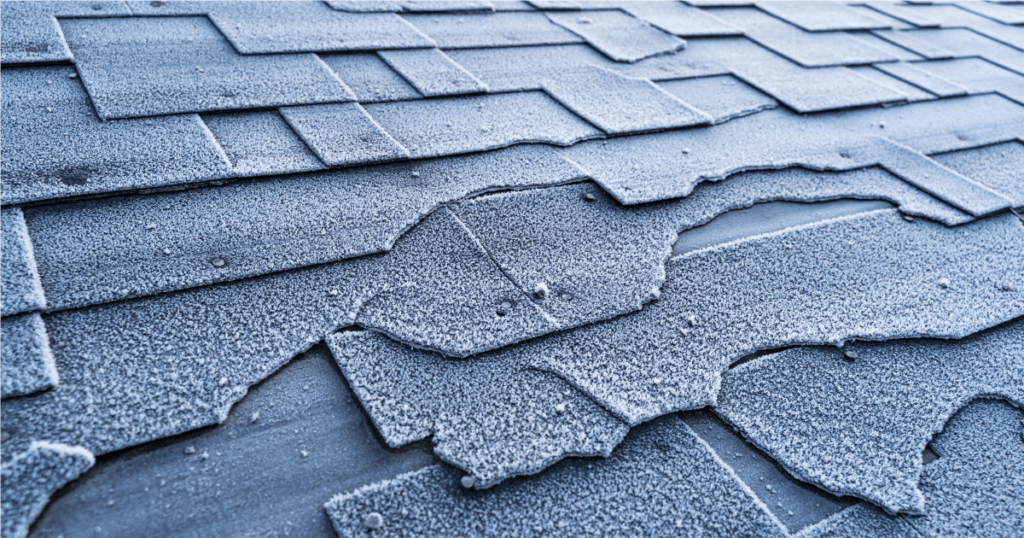
Asphalt shingles are the dominant roofing material across rural southern Idaho, and their performance here is shaped by two forces working in opposite directions seasonally. Summer in the Magic Valley is intense by any measure. Cassia County regularly sees July and August high temperatures above 95 degrees, and a dark asphalt shingle surface absorbs and radiates that heat at a level that accelerates the oxidation of the asphalt binders holding the granules in place. The granules are what protect the fiberglass mat beneath from UV degradation. As they loosen and wash off over years of summer exposure, the mat becomes increasingly vulnerable.
Then winter reverses the cycle. Snow accumulates on roofs across south-central Idaho with enough weight and duration to stress the deck beneath the shingles, and more significantly, the freeze-thaw pattern of late winter and early spring creates the conditions for ice damming. When the lower section of a roof holds snow and ice while the upper section, warmed by interior heat loss, melts and sends water running downhill, that water refreezes at the cold eave edge. The ice dam forces water back up under shingles at exactly the point where the angle of the roof does not naturally drain. This is how attics and wall cavities in Idaho homes take on water damage that does not become visible inside the house until it has been building for a full season.
The national standard lifespan estimate for a 30-year architectural shingle is 25 to 30 years in a moderate climate. In south-central Idaho, 18 to 22 years is a more realistic expectation for a roof that was installed with standard practices and standard ventilation. Better attic ventilation, which reduces the heat differential that drives ice dams, and impact-resistant shingles rated for hail extend that timeline. A roof approaching 15 years in this climate warrants a professional inspection regardless of whether anything looks obviously wrong from the ground.
How Idaho Wind and UV Exposure Ages Siding Faster Than Expected
Siding in the Magic Valley ages under a specific and persistent combination: strong prevailing winds that carry fine alkaline dust and grit from the surrounding agricultural land, direct summer UV exposure at an elevation and latitude that produces meaningful solar intensity, and temperature swings between winter lows and summer highs that cause repeated expansion and contraction in any material that is not designed to handle it.
Vinyl siding, which is common on homes built in the 1990s and 2000s across Burley, Rupert, and Heyburn, becomes brittle with prolonged UV exposure. The plasticizers that give vinyl its flexibility off-gas over time, and what remains is a material that cracks under impact or thermal stress rather than flexing. The surface also oxidizes, losing its original sheen and taking on a chalky, faded appearance that no amount of cleaning restores. Once vinyl has reached this stage, it is also losing its dimensional stability, and gaps at laps and corners that were previously tight begin to open, creating pathways for moisture and wind-driven rain to reach the sheathing beneath.
Fiber cement siding, which has become the replacement of choice for many Magic Valley homeowners, handles UV and thermal cycling considerably better. Its dimensional stability under temperature swings is significantly better than vinyl, and it does not develop the brittleness that makes old vinyl siding vulnerable to physical damage. The tradeoff is that fiber cement requires repainting on a cycle of eight to twelve years to maintain its moisture resistance, and in Idaho’s alkaline dust environment, that surface needs to stay intact. A fiber cement installation that is not maintained will still outlast old vinyl, but it is not genuinely maintenance-free.
For homes with wood lap siding, which appears on older properties throughout the region, the combination of dry summer heat and winter moisture creates chronic checking, splitting, and paint failure that allows water infiltration at the board ends and at any penetration point. Wood siding that has been properly maintained can last decades, but south-central Idaho’s climate is not forgiving of deferred maintenance. A five-year gap in repainting cycles often represents a ten-year reduction in the siding’s remaining useful life.
Why Idaho Decks Fail From the Bottom Up, Not the Top Down
The most common misconception about deck condition is that the walking surface tells the story. Homeowners look at their deck boards, notice they are weathered but solid, and conclude the deck is fine. In south-central Idaho’s climate, the structural failure almost always begins not in the decking material but in the posts, the ledger connection to the house, and the joist ends. These are the places where moisture accumulates through freeze-thaw cycles, where debris collects and stays wet, and where wood rot establishes before it is ever visible from above.
Pressure-treated lumber in contact with the ground or in a ground-adjacent condition in Idaho’s freeze-thaw environment has a functional life of roughly 10 to 15 years before the protection from the treatment begins to be compromised by the repeated moisture cycling. Posts that sit in concrete footings and hold standing water at the base, which is the standard detail on many older decks in this region, are the first structural element to degrade. By the time the post surface looks obviously soft, the wood at its core may have been compromised for years.
The ledger connection, where the deck attaches to the house rim joist, is the second failure point. Flashing that was installed incorrectly or has failed over time allows water to run behind the ledger board and into the wall framing. This type of damage is invisible from the outside and often not discovered until a deck replacement reveals rot in the house framing that requires repair before the new deck can be attached. Having the ledger connection inspected on any deck over ten years old is worthwhile before that discovery happens mid-project.
Composite decking has largely replaced pressure-treated pine as the surface material of choice for new deck construction in the Magic Valley, and it performs well here. The high UV environment does not degrade composites the way it fades and bleaches natural wood, and the moisture cycling that splits and checks natural wood boards does not affect a well-manufactured composite plank. The structural framing beneath it, however, is still subject to the same conditions, and composite decking over deteriorated framing is simply a better-looking version of the same problem.
The Best Time to Have Exterior Systems Assessed in Idaho
Early spring, after the last freeze and before the main construction season begins, is the ideal time for a thorough exterior inspection in south-central Idaho. Winter reveals failure points that are not visible in summer: ice dam staining on the soffits, siding that has buckled under thermal cycling, deck boards that have lifted or cupped after snow melt, and flashing that has separated at wall penetrations. Getting ahead of those findings in March or April rather than discovering them in June, when contractor schedules are full, is the difference between a planned replacement and an emergency call.
Element Restoration Serves Roofing, Siding, and Deck Replacement Across Southern Idaho
The wear patterns on a Burley home’s exterior are not the same as what a contractor in a temperate climate is trained to look for. South-central Idaho’s specific combination of stressors requires someone who has seen enough local projects to recognize what is cosmetic, what is structural, and what needs to be addressed before the next winter season makes it worse.
Element Restoration handles roofing, siding, and deck replacement for homeowners across Burley, Twin Falls, Rupert, Heyburn, Gooding, Jerome, Paul, Minidoka, and the surrounding communities within a 100-mile radius. If your roof is getting close to 15 years, your siding has started showing the oxidation and brittleness that precedes failure, or you have not had your deck’s structural members inspected in the past few years, spring is the right time to have that conversation before the construction calendar fills. Reach out through elementbuilding.net to schedule an assessment.